
OT Shine Therapy

Shine Therapy Services
Shine Therapy Services is an independent consultancy offering occupational therapy and sensory integration therapy for children and young people. Our therapy services benefit children and young people who have recognised medical / physical conditions, or regulatory, learning, social and emotional difficulties and all those who simply require some additional support with aspects of their development.
Three Tiers of OT Provision:
Within Knowsley Central School, the occupational therapy service is delivered across 3 distinct tiers of therapy provision; universal, targeted and specialist.
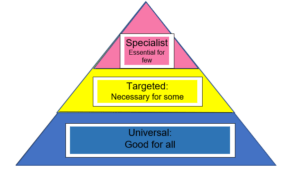
- Universal: The occupational therapy universal provision ensures an accessible sensory environment and regulatory strategies for all pupils imbedded within the class routines and whole school environment. For example, the classes access sensory circuits, fidget items, weighted equipment and many more sensory tools. Within this tier of therapeutic provision, it is the role of the occupational therapist to provide ongoing support for teaching support staff to implement a range of sensory intervention.
- Targeted: Where it is felt needed, the occupational therapist provides targeted assessment (i.e. observational / consultation with other members of staff / clinical observations / sensory assessment) for some pupils to help staff identify their person-specific sensory needs. This is relevant for pupils who may be experiencing sensory-related barriers or regulation difficulties which are impacting on their participation, learning, and overall ability to effectively self-regulate. These pupils are provided with a holistic and personalised sensory diet in which each sensory behaviour is individually identified, and strategies are provided to staff and parents to meet the presenting underlying need.
- Specialist: For only a few children, the occupational therapist’s expertise may be needed to complete more detailed assessment or ongoing therapist presence / modelling within the classroom environment.
Education settings are complex and demanding environments and, to navigate these successfully, pupils require a range of physical, cognitive, and functional skills. Any difficulties relating to these skills may have a detrimental impact on the attainment, behaviour or well-being of a child or young person. Ensuring that students’ sensory needs are met throughout their waking day provides them with a strong foundation from which they can build such skills, meet developmental milestones, and achieve success in functional tasks. The coming academic year sees an expansion in the occupational therapy service provision within Knowsley Central School with an added specialist focus on areas such as promoting self-care skills, fine-motor skills for handwriting and emotional understanding and regulation.
Sensory Diets
All students at Knowsley Central are assessed by the occupational therapist to determine if they have any additional sensory processing needs and which therapeutic provision their presenting needs falls under. Students are then provided with a whole-class sensory diet inclusive of universal strategies which promote an accessible and effective learning environment. However, some students are identified as requiring more in-depth assessment and provision of more robust, targeted sensory diet.
Sensory diets are personalised plans which identify a young person’s specific sensory-based behaviour and advise various strategies to help them meet their underlying sensory need. Strategies may include physical movement and activity (such as completing a sensory circuit), retreat to a quiet space with minimal sensory stimuli, and accessing specialist equipment (such as weighted jackets and blankets). The diets are highly structured, giving a clear indication as to when each strategy should be used. Much like a regular diet, sensory diets are to be done consistently each and every day to ensure a young person can maintain a ‘just right’ level of regulation throughout the day.
Staff at Knowsley Central have been trained in how to implement sensory diet strategies and continue to receive regular coaching and mentoring from the onsite occupational therapist to ensure pupil’s are able to successfully access all of their recommended sensory diet interventions.
Sensory Circuits
Under the guidance of the occupational therapist, a variety of sensory circuits have been set up at Knowsley Central, meaning that all students have the opportunity to access this particular sensory intervention throughout their school day.
A sensory circuit is a structured movement-based activity which involves the integration of both sensory and motor skills. Each sensory circuit is comprised of three stations which the pupils complete in order: the ‘alerting’ station, the ‘organising station’, and the ‘calming’ station. This structure is carefully designed to help alert, organise and then relax the senses of children so they can achieve a ‘just right’ level of alertness that is needed to set them up well for the demands of their school day. If they are feeling tired or sluggish on arrival to school, a sensory circuit can help to wake them up, ready to start their day. If they are feeling giddy after a breaktime spent running on the playground, a sensory circuit can help them to calm and relax, ready to focus on their schoolwork.
In addition to supporting their self-regulation, the sensory circuits also offer opportunities to help improve motor skills (such as improving balance), to practice social skills (such as turn-taking), work on attention and concentration (focussed activity) and to practise what they are learning in class (such as counting or recognising colours).
Zones of Regulation
Over the course of this new academic year, our therapy team have been working closely together to implement our new personal, social and emotional curriculum here at Knowsley Central. As part of this change, the school have begun to use the Zones of Regulation in all classes. The Zones of Regulation framework and curriculum teaches students scaffolded skills towards building awareness of their feelings and internal states, developing pro-social skills and utilising a variety of tools and strategies to support their regulation. This includes exploring tools and strategies for mindfulness, sensory integration, emotional regulation, positive thinking, wellness, and developing healthy connection with others. The framework provides a universal language and compassionate framework to support positive mental health and skills development around effective emotional acknowledgement and regulation.
The Zones of Regulation framework splits different emotions / internal states of alertness into four coloured categories. The Red Zone is used to describe extremely heightened states of alertness and intense emotions. A person may be elated or experiencing anger, rage, devastation, or terror when in the Red Zone. The Yellow Zone is also used to describe a heightened state of alertness and elevated emotions, however one has more control when they are in the yellow zone. A person may be experiencing stress, frustration, anxiety, excitement, silliness, the wiggles, or nervousness when in the Yellow Zone. The Green Zone is used to describe a calm state of alertness, this is the zone where optimal learning occurs. A person may be described as happy, focussed, content, or ready to learn when in the Green Zone. The Blue Zone is used to describe low states of alertness and down feelings such as when one feels sad, tired, sick or bored.
Knowsley Central are using the Zones of Regulation framework within all classes as a whole school therapeutic approach. The program has been carefully adapted to best meet and compliment the needs of each individual pupil. In order to do this, the wider educational support team are facilitating lessons within the curriculum, whole school displays, practical activities and multiple timetabled daily check-ins with pupils. If you want to further support your child in accessing this program and the learnt skills at home please speak to the teaching support team within your class for more information and direction to the appropriate resources.


